Best for
Textiles, clothing, çeyiz, everyday shopping, specialist hans and local market atmosphere.
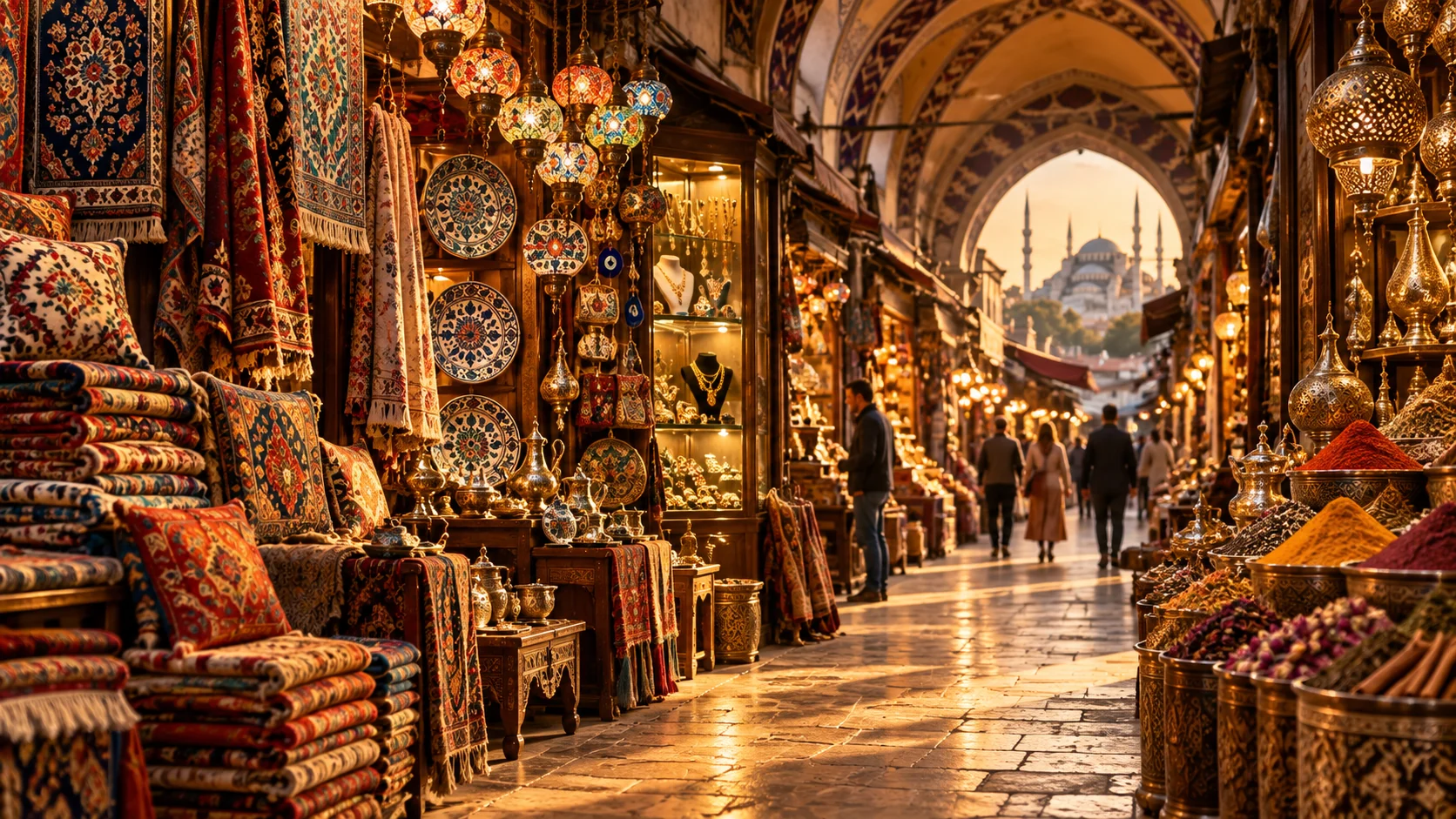
The Grand Bazaar is only the beginning. This downhill route follows Istanbul's old commercial spine through working hans, textile streets and specialist markets — ending at the Spice Bazaar.
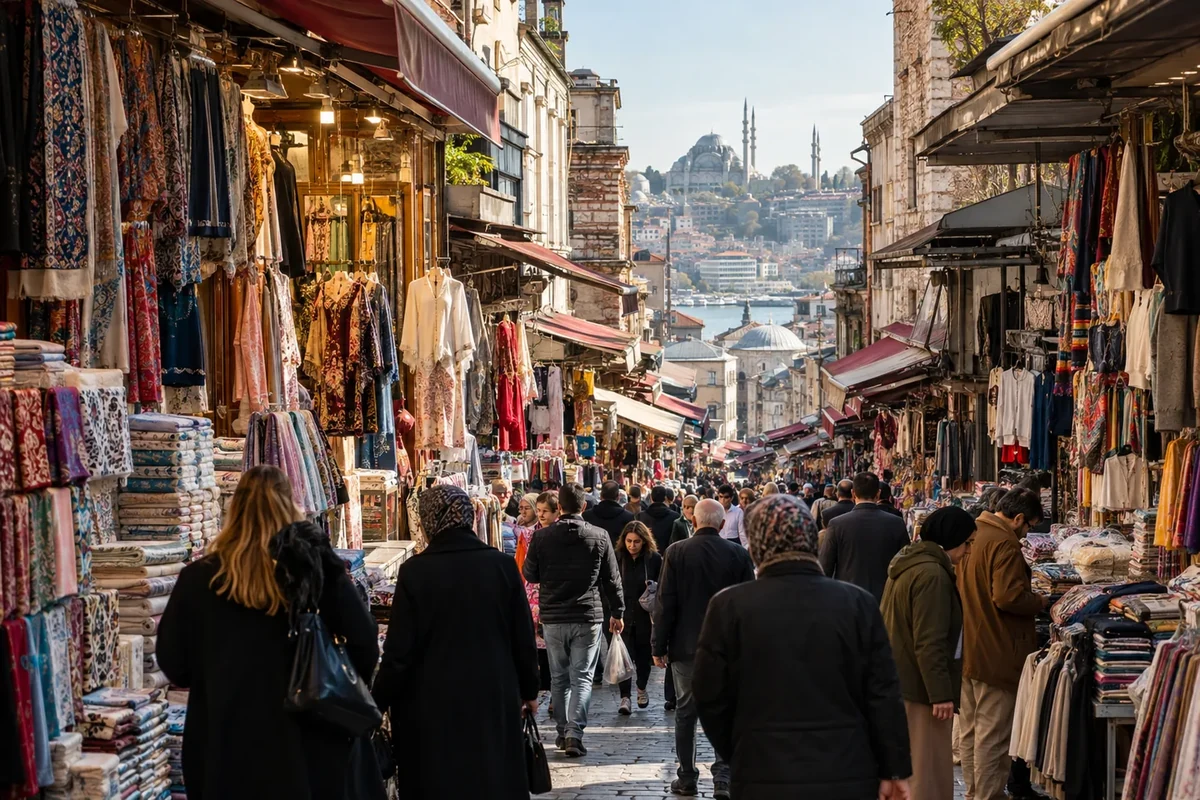
For centuries, goods moved between the waterfront, Tahtakale, merchant hans and the covered bazaar uphill. The useful modern version of that story is still visible: one han is known for silver workshops, another for yarn and bag materials, another for barber supplies, while nearby passages specialise in trousseau, wedding goods or accessories.
This route deliberately follows that logic rather than collecting monuments at random.
Starting inside the covered market? Use our Grand Bazaar guide to plan the hours, entrance and shopping visit.
Hover over a marker for the quick answer. Click it for the local story, what to buy, and a direct Google Maps link.
Read all 12 stops below, or use Google Maps for live street routing. The interactive map loads when you choose it.
Craft & Ottoman trade
A quieter courtyard behind the Grand Bazaar's intensity. Built in 1708, Zincirli Han still carries an artisan-and-merchant character rather than a souvenir-mall feel.
What to look for / buy Anatolian rugs, jewellery and traditional handicrafts
Local note: Start here slowly. It works best as an atmosphere stop: look into the workshops and compare craft before buying.
Kapalıçarşı, Zincirli Han, Fatih, İstanbul
The transition point
This is the useful mental border: behind you is the monumental Grand Bazaar; ahead is the downhill commercial city of Mahmutpaşa, hans, workshops and everyday retail.
What to look for / buy No shopping target — this is where the route changes character
Local note: From here, stop treating the walk as a list of attractions. Follow the product clusters and side passages.
Kapalıçarşı Mahmutpaşa Kapısı, Beyazıt, Fatih, İstanbul
15th-century anchor
The mosque belongs to the 15th-century Mahmud Paşa complex that helped shape this district after the conquest. The original complex included commercial and civic functions as well as religious buildings.
What to look for / buy Nothing — a short historical pause
Local note: Give it ten quiet minutes. It explains why commerce, worship, hans and workshops sit so tightly together here.
Vezirhan Cd. No:100, Fatih, İstanbul
Trousseau & everyday textiles
One of the clearest 'what locals actually come here for' stops. This is practical shopping, especially around household textiles and wedding/trousseau needs.
What to look for / buy Towels, lingerie, pyjamas, nightwear and çeyiz / trousseau goods
Local note: Compare two or three shops before buying; very similar-looking textile goods can differ a lot in fabric weight and finish.
Mahmutpaşa Cd. No:45, Fatih, İstanbul
Yarn & bag-making supplies
One of the early Ottoman commercial hans in the Mahmutpaşa district. Today the useful local-shopping angle is still very concrete: yarn and bag materials.
What to look for / buy Yarn, knitting / craft materials and bag-making supplies
Local note: This is a sourcing stop, not a polished tourist attraction. Ask whether a shop sells retail before assuming the displayed quantity is the minimum.
Mahmutpaşa Yokuşu No:131, Fatih, İstanbul
Silver craft workshops
This is the silver stop. Anadolu Ajansı's June 2026 'İstanbul'un Han ve Çarşıları' series documents Büyük Yeni Han as a present-day centre of silver handicraft workshops, after centuries of commercial use.
What to look for / buy Silver craftsmanship; the real attraction is the workshops and production culture
Local note: Look for the production side, not just finished jewellery. The point is seeing a working craft ecosystem inside a nearly 300-year-old commercial building.
Çakmakçılar Yokuşu, Büyük Yeni Han, Fatih, İstanbul
Living caravanserai
Built in the 17th century under Kösem Sultan, this was one of the city's major merchant hans. It still functions as a commercial building with shops, workshops and storage rather than as a frozen museum.
What to look for / buy Mixed small trade, workshops and stores — come mainly for the living-han atmosphere
Local note: Treat the courtyards and working atmosphere as the experience. Do not promise roof access: access and conditions can change.
Çakmakçılar Yokuşu No:33–39, Mercan, Fatih, İstanbul
Bags, belts & accessories
Mercan is part of the route's shift from Mahmutpaşa textiles toward specialist trade. The han and surrounding Uzunçarşı shops include bag-and-belt businesses.
What to look for / buy Bags, belts, wallets and related accessories; some businesses are wholesale-oriented
Local note: Ask 'perakende var mı?' if you only need one item. Some counters are used to wholesale quantities.
Uzun Çarşı Cd. No:96, Fatih, İstanbul
Wedding & celebration supplies
A classic Tahtakale specialist-shopping stop. İBB's local shopping guide points visitors here for kına, engagement, nikâh/wedding supplies and kitchen-related goods.
What to look for / buy Kına, engagement, wedding/nikâh supplies, gift packaging and decorative goods
Local note: This is more useful when you enter with a category in mind. The density can feel chaotic if you are simply browsing.
Vasıf Çınar Cd. No:17, Tahtakale, Fatih, İstanbul
Barber & hairdressing supplies
One of the route's best 'why would a tourist know this?' stops. The Zaza business tradition dates to 1917 and remains strongly associated with barber and hairdressing equipment.
What to look for / buy Clippers, scissors, hair dryers, barber tools, hair-care and personal-care products
Local note: Even if you buy nothing, it shows how Eminönü works: whole buildings become known for one trade category.
Tahtakale Cd. No:20, Fatih, İstanbul
From honey depot to mixed trade
Its name remembers the Ottoman 'kapan' system: goods such as honey were checked, stored and distributed here. Anadolu Ajansı reported that the han still hosts a striking mix of small commercial trades.
What to look for / buy Paper/notebooks, boxes, jewellery-related goods, electronics, flowers, salep and spices vary by shop
Local note: The appeal is the contrast: a centuries-old distribution hub still doing ordinary commercial work, just with completely different products.
Balkapanı Sk., Tahtakale, Fatih, İstanbul
Food-market finish
The natural finish: after craft, textiles, specialist trade and Tahtakale, the route arrives at one of Istanbul's best-known food bazaars.
What to look for / buy Spices, nuts, sweets, lokum and food gifts
Local note: Save food shopping for the end. You can continue from here into Eminönü street food or the ferry waterfront without climbing back uphill.
Rüstem Paşa, Fatih, İstanbul
The map tells you where to walk. This part tells you what to notice while you are there.
If the Grand Bazaar is the Istanbul market you already know, Mahmutpaşa is the market district you discover when you keep walking. It is not one monumental covered building with a single gate and opening time. It is a dense network of sloping streets, hans, arcades and small shops running downhill toward Eminönü.
The useful thing for a visitor is that the shopping still has a local logic. Product categories cluster together. One stretch leans toward towels and household textiles, another toward dresses, scarves or children's clothes, while nearby hans specialise in materials, tools or particular trades.
The best way to experience Mahmutpaşa is not as a “sight”. Treat it as a local shopping walk through Istanbul's old commercial city.
| Category | What you will see |
|---|---|
| Textiles & linens | Towels, tablecloths, bed linen, lace, household fabrics and practical home textiles. |
| Çeyiz / wedding shopping | Nightwear, linens, decorative textiles, accessories and household goods traditionally bought around marriage. |
| Clothing & accessories | Ready-to-wear fashion, underwear, scarves, children's clothes, bags and small accessories. |
| Tahtakale side | Kitchenware, household goods, packaging, hardware and more trade-oriented specialist shops. |
The Grand Bazaar is a historic monument as much as a market: vaulted streets, formal gates and a strong visitor economy. Mahmutpaşa feels more like the commercial city spilling into the street — less polished, less monumental and more focused on practical goods.
If you want one iconic market interior, choose the Grand Bazaar. If you want to see how historic Istanbul commerce still works in everyday life, continue downhill into Mahmutpaşa. The strongest visit combines both.
There is no single official “Mahmutpaşa opening time” because this is a district, not one centrally managed market. For a visitor, Monday to Saturday, late morning to mid-afternoon is the safest pattern. Sunday is unreliable if your main purpose is shopping.
And use the geography: walking from the Grand Bazaar downhill toward Eminönü is simply more pleasant than doing the same route uphill.
Textiles, clothing, çeyiz, everyday shopping, specialist hans and local market atmosphere.
About 20–30 minutes if you only walk. Plan 3–4 hours if you actually enter the hans, browse and stop for food.
Grand Bazaar → Mahmutpaşa → Mercan → Tahtakale → Spice Bazaar. Mostly downhill.
This is a working commercial district. Deliveries, narrow passages and busy shop entrances are part of daily life.
Do not come only looking for souvenirs. The interesting part is seeing how the city still organises trade by product, street and han.
Several remain ordinary places of work: shops, depots and workshops. That is the point. Respect doors, deliveries and people working inside.
Keep the distinction clear: the documented 2026 silver-workshop centre is Büyük Yeni Han, not Büyük Valide Han.
Kürkçü Han for yarn/bag materials, Zaza Han for barber supplies, Şark Han for celebration goods: this is how locals use Eminönü.
Markers are editorial waypoints. The connecting line shows the intended visit order; it is not a turn-by-turn pedestrian navigation engine. Use the Google Maps button for live street routing, closures and access conditions.
Last researched: 4 October 2026.
No. They are neighboring parts of Istanbul's historic commercial area, but Mahmutpaşa is an open street-and-shop district rather than the Grand Bazaar's enclosed monumental complex.
The Turkish spelling is Mahmutpaşa. Search results may also use Mahmutpasa, Mahmutpasha Bazaar or “Mahmut Pasha.” They generally refer to the same old-city shopping area.
Especially clothing, accessories, textiles and trousseau/wedding shopping. The official Istanbul tourism guide specifically identifies Mahmutpaşa with çeyiz, giyim, aksesuar — trousseau, clothing and accessories.
It can be, but that is not its strongest reason to visit. If you want mass souvenir shopping, the Grand Bazaar and tourist corridors offer more. Mahmutpaşa is more interesting for practical goods, textiles and the local shopping atmosphere.
Yes. That is one of the most natural ways to experience the district: descend through Mahmutpaşa and Tahtakale toward Eminönü and the Spice Bazaar side.
There is no single authority setting hours for every shop. Many businesses and arcades operate mainly Monday–Saturday, so Sunday is not the day we would choose for a shopping-focused visit.
Choose another district with our shopping in Istanbul guide.
For another day on foot, follow our Beyoğlu walking route from Taksim to Eminönü.